



June 2026 Heirloom Bean and Grain Club
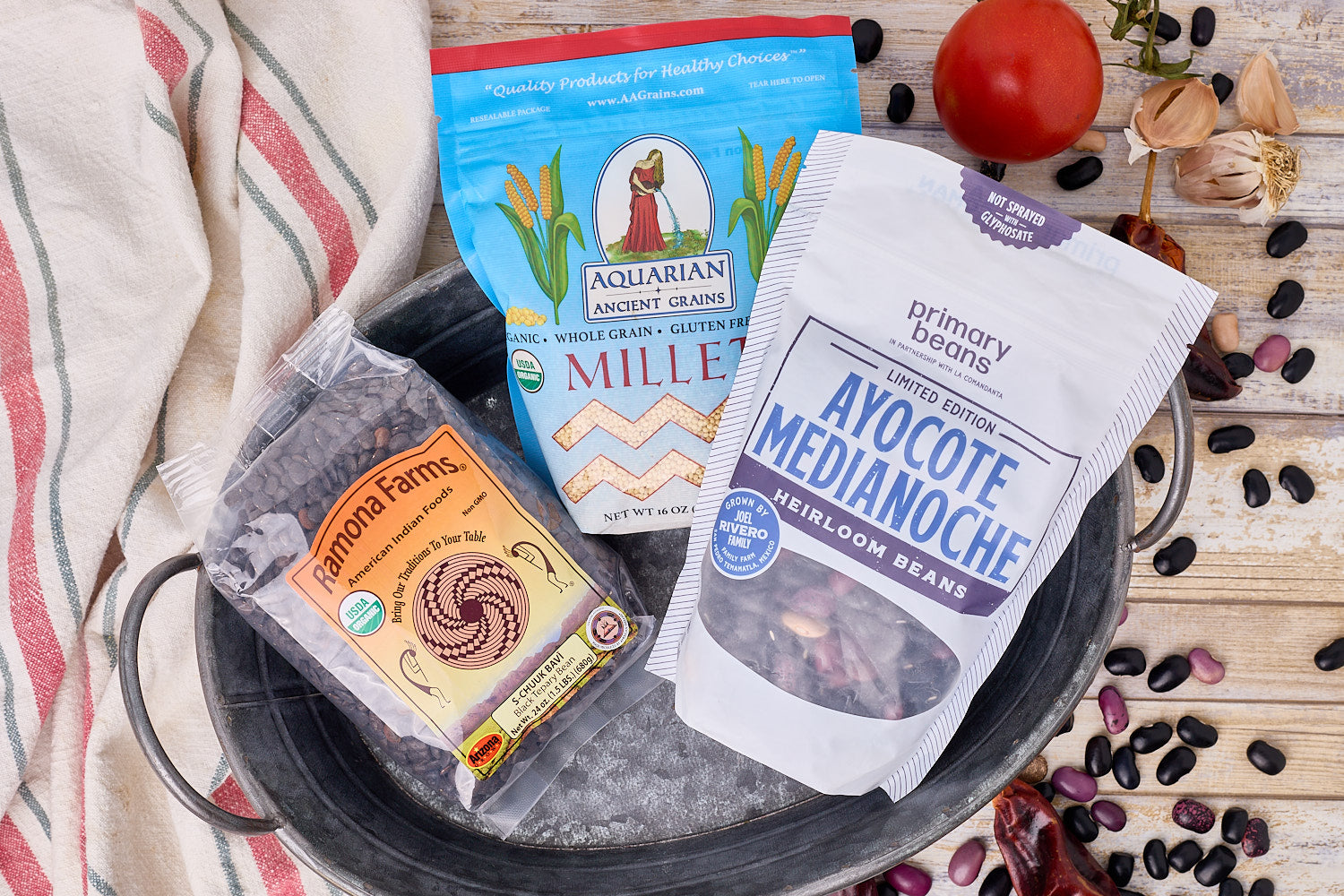
We've bean waiting all year for this one. June's Heirloom Bean and Grain Club is making history — our members are the very first people outside of Mexico to try the Medianoche. Not the first in the US. The first in the world outside of Mexico. We named this stunning ayocote bean for the Joel Rivero family, the small family farm in Puebla that grows it, and we've given that name to the world to live in the public domain forever. Look for the Free the Bean stickers in your box — that's what they're all about. Now, we know it's hard to tear your eyes away from those gorgeous deep black and purple beans, but wait, there's more. Also in your box this month are Black Tepary beans, ancient organic heirloom beans of the American Southwest grown by an indigenous woman farmer, and a certified organic, gluten-free Millet from a family farm in Colorado, one of the most ancient grains on earth. Long live the legume liberation!
BEAN AND GRAIN BOX CONTAINS:
Medianoche Heirloom Beans, Black Tepary Beans, Organic Millet
THE BEAN ONLY CONTAINS:
Medianoche Heirloom Beans, Black Tepary Beans, Black Garbanzo Beans

OUR CUSTOMER PORTAL
You can easily claim rewards, add to your next shipment and so much more! We made a video walking you through exactly how easy it is to add some goodies to your order and get cash back. WATCH THE VIDEO.
NEW TO THE CLUB? First of all, congratulations on scoring a spot. It's going to be harder to get in this year because of low yields from key farmers like Blue House Farms. Check out our blogposts with everything you need to know to get the most out of your membership in the heirloom bean and grain club.
How To Cook A Perfect Pot of Beans
The Definitive Guide To Cooking Beans

Ayocote Medianoche Heirloom Beans
 The Ayocote is one of the oldest cultivated beans in the world — grown in the Puebla region of Mexico for over 6,000 years, predating the Aztec empire itself. A runner bean in the same family as the scarlet runner you may know from American gardens, but far more ancient, far more storied, and in the case of the Medianoche, far more extraordinary. Named for the Spanish word for "midnight," this rare variety is grown by the Joel Rivero family in San Pedro Temamatla, a small mountain village in Puebla, using traditional farming methods passed down through generations and no synthetic chemicals or fertilizers. In Mexico, beans like these are rarely grown by large industrial operations — they are the livelihood of small shareholder farmers, and the Medianoche is no exception. The Rivero family's harvest supports their entire village, and every bag you bring home creates the sustainable income that keeps this ancient variety — and the people who grow it — alive.
The Medianoche itself is a showstopper: enormous, shiny-coated beans in a dramatic mix of deep black, rich purple, and cream — no two handfuls exactly alike. Cook them low and slow and they reward you generously, holding their shape through long braises while producing a thick, inky broth with a bold, earthy flavor that is almost impossible to resist in soups, stews, and sauces. We named this bean — and we've officially placed that name in the public domain, because nobody should own a bean. Read why. Primary Beans sources the Medianoche through our partnership with La Comandanta, a Mexican mission-based company working directly with small family farms to rescue ancestral varieties at risk of disappearing. This is a rare, limited harvest.
ABOUT THE FARMER
Joel Rivero and his stepfather farm together in San Pedro Temamatla in the high valleys of Puebla — a region where the altitude and seasons set the terms and you work around them, not the other way around. They farm the way the community always has: rotating sections so the land can rest, fertilizing with animal manure from the region, never touching the soil with synthetic fertilizers or chemicals of any kind. Harvesting is done by hand, and seed selection grain by grain — only the best makes it back into the ground. It's what we now call regenerative agriculture; Joel calls it the way it's always been done here. The Medianoche itself was a happy accident — the result of mixing several Ayocote varieties during a difficult drought year, with little water and low expectations. What came back was something nobody had seen before, and that others in the region haven't been able to replicate since. "I don't know if it's the soil, the location, the work, or the management," Joel says, "but thank God, that's the result we get." Primary Beans is proud to partner with La Comandanta, a Mexican mission-based company working directly with small family farms to rescue ancestral varieties at risk of disappearing. Together we are thrilled to bring the Medianoche to the world.
WHAT TO MAKE WITH THEM
The Medianoche means business in the kitchen. This big, meaty Ayocote delivers a bold, earthy flavor and a rich, inky broth that turns a simple pot of beans into something you'll want to eat straight from the bowl. Because it holds its shape beautifully through long, slow cooking, it has always been the bean of choice for stews and soups across the Mexican highlands — and once you taste it, you'll understand why.
The most traditional preparation is also the most rewarding: a pot of beans simmered low and slow with plenty of chilis, salt, cumin, and avocado leaves. Avocado leaves are the classic aromatic here, lending a subtle anise note that is deeply characteristic of this style of cooking. If you can find them, use them. If not, a combination of bay leaf and a piece of kombu gets you there — add a pinch of fennel seed to the pot and you'll capture that signature anise warmth beautifully. Here's my easy Ayocote Pressure Cooker recipe for when you just want them done.

From there, the Medianoche opens up into some truly spectacular territory. Cook them into a rich Mole and serve with warm tortillas for one of the great bean experiences of your life. Try them as Frijoles con Salsa Macha for something bold and deeply savory. Our Wild Mushroom and Caramelized Onion Bean Bowl turns the Medianoche into a hearty vegan feast that is as gorgeous to look at as it is to eat. And when summer hits hard, nothing shows off that stunning color and earthy depth quite like my Marinated Medianoche Bean Salad — a perfect make-ahead staple that gets better the longer it sits.
ORGANIC TEPARY BEANS
The tepary bean has been handed down for countless generations amongst the Akimel O’Odham (River People, Pima) people and the Tohono O’Odham (Desert People). It is native to the Sonoran Desert and has been cultivated by the indigenous people of the region for 4,000 years.The bavi or tepary bean, is the most drought adapted species of bean in the world.
Tepary beans are culturally very important to indigenous people of Southern and Central Arizona. It is said that the Tohono O’Odham, once referred to as Papago, were named after Papavi Kuadam which means ‘tepary eaters’. The tepary bean was once a large part of the indigenous diet in the Sonoran Desert, farmed in abundance along the Gila river. The reservation system caused a loss of traditional farming traditions and in the later 1800s the river was dammed and diverted with devastating effects. By the 1950s the tepary had all but disappeared. Due to the efforts of Ramona Farms the Akimel O'Odham people once again grow the tepary bean on their tribal land.

WHAT TO DO WITH THEM
With their earthy flavor and creamy texutre, brown tepary beans make are an excellent choice for everything from salads to spreads. This simple recipe for Tepary Beans On Toast makes a fantastic lunch, snack or appetizer for those days when you don't want to spend much time in the kitchen. Brown Tepary make an excellent substitution for Arikara in this Hominy Bean Salad. Make a simple pot of beans to serve with some grilled Tri-Tip for the California experience. Of course your tepary bean experience would not be complete without an indigenous recipe by The Souix Chef, Shawn Sherman. We are head over heals for his tepary beans with chili agave glaze.

ABOUT THE FARMER
We are honored that Ramona is sharing with us the food traditions of her tribe, the Akimel O'Odham (Gila River Pima) Community. Ramona's father, Francisco ‘Chiigo’ Smith, an O’dham farmer, grew many traditional crops on the Gila River Indian Reservation in Arizona. Her mother was an herbalist and traditional healer. Together they taught Ramona the value of their traditional foods and way of life. She continued the traditions with her own family, farming on this ancestral land with her husband.
In the late 1970’s, some community elders asked Ramona and her husband us to grow the Bafv (tepary bean), which had nearly become extinct due to the lack of water that put many of the local subsistence farmers out of business. They discovered that her father had left a few seeds of the white and brown tepary beans in glass jars in a trunk in the old adobe house that she grew up in. They knew that it was to become their mission to ‘bring the bafv back’ to the community.
The tepary bean is part of the Slow Food Ark of Taste and its roots go back thousands of years in our native foodways. The remains of the tepary have been found in archeological sites in Mexico that are 5,000 years old and it has been grown in what is now California and Arizona for thousands of years. This incredibly hearty bean was a staple food source for Native American tribes who cultivated it to survive in the incredibly arid conditions.
It is through Ramona's tireless efforts that we can now enjoy this delicious part of our American cultural heritage and honor the traditions of the Akimel O'Odham people and their ancestors that have cared for the land for generations.
ORGANIC WHOLE GRAIN MILLET
If you're not cooking with millet yet, June is your month. Naturally gluten free, rich in magnesium, phosphorus, and antioxidants, high in fiber and plant-based protein, and easier to digest than most grains — millet is genuinely one of the most nutritious things you can add to your pantry. And unlike a lot of "superfoods" that arrived yesterday with a marketing budget, millet has been earning that reputation for about 10,000 years.
One of the oldest cultivated ancient grains on earth, millet was first domesticated in China and Africa, where it became the backbone of entire civilizations long before wheat and rice dominated the global table. It spread across Asia, the Middle East, and into Europe, feeding armies, sustaining empires, and nourishing communities through droughts and hardships that would have wiped out more demanding crops. Then industrial agriculture arrived, wheat and corn took over the world's fields, and millet got quietly pushed to the margins. Which is a shame, because millet never stopped being extraordinary.
It is also one of the most sustainable crops you can grow. Millet thrives in poor soils with minimal water, requires no synthetic inputs to produce a good harvest, and builds rather than depletes the land it grows on. In a world increasingly reckoning with the environmental cost of commodity agriculture, millet is the grain that was right all along. Our Organic Millet comes from a family farm committed to growing it the way it deserves — without shortcuts, without synthetics, and with the kind of care that honors a 10,000 year legacy.

WHAT TO DO WITH IT
Millet is wonderfully easy to cook, which makes it one of the most weeknight-friendly grains in the pantry. On the stovetop it comes together quickly — in about 15 to 20 minutes it cooks up light and fluffy, with a texture remarkably similar to couscous. Add a little more liquid and let it go a few minutes longer and it transforms into a warm, creamy porridge that is deeply comforting on its own or topped with whatever you have on hand. Two very different results from the same pot, depending on what you're in the mood for.
From there, millet's versatility really opens up. Swap it in anywhere you'd normally reach for quinoa or couscous and it performs beautifully, soaking up dressings and aromatics with the same light, grain-forward texture. It's fantastic as a base for grain bowls, tossed into summer salads, or served alongside your favorite stew in place of rice. For a hearty summer dinner try my Spring Millet, Black Bean Buddah Bowl with Lemon Tahini Dressing. Try this delicious garlic spinach, millet and egg dish from Naturally Ella for breakfast. I'm also working on a black bean millet cake recipe so watch your inbox for that one. If you've been sleeping on millet, consider this your wake-up call.
ABOUT AQUARIAN ANCIENT GRAINS
 Don and Joan Bielak didn't set out to start a grain company — they set out to eat better. When the couple began researching ways to improve their diet, millet kept coming up: gluten free, blood sugar stabilizing, rich in magnesium, phosphorus, iron, and copper, and genuinely delicious. Sold. The only problem was they couldn't find it anywhere — not at their local grocery store, not at the health food stores nearby. When they finally tracked down a package and tasted it for the first time, the path forward became clear. If millet was this good and this hard to find, maybe the answer was to do something about it. Aquarian Ancient Grains was born.
Three years in, Don and Joan are still running the company themselves, with a simple and non-negotiable standard: every product they carry must be both USDA certified organic and Non-GMO Project certified. No exceptions. They source their millet domestically from family farms in Colorado and Oregon, where USDA regulations ensure rigorous farming standards — a meaningful distinction in a market where plenty of millet comes from overseas operations with far less oversight.
One of their standout farm partners is Golden Prairie Farm in Colorado, a multigenerational family operation that specializes in careful millet cultivation and, by all accounts, does it exceptionally well. It's exactly the kind of farm relationship Don and Joan built this company to support — people who take the craft seriously, grow it right, and produce something worth putting your name on.

The Heirloom Bean + Grain club
Learn More
Get impossible to find beans and grains shipped direct to your doorstep each month from small family farms.

Support small family farms
Shop Now
We support small, family owned farms across the nation. Did you know that farmers only make an average of 10 cents on every dollar you spend at the supermarket? Working directly with farms and not middle men ensures that more money goes back to the people actually growning your food.