



April 2026 Heirloom Bean And Grain Club
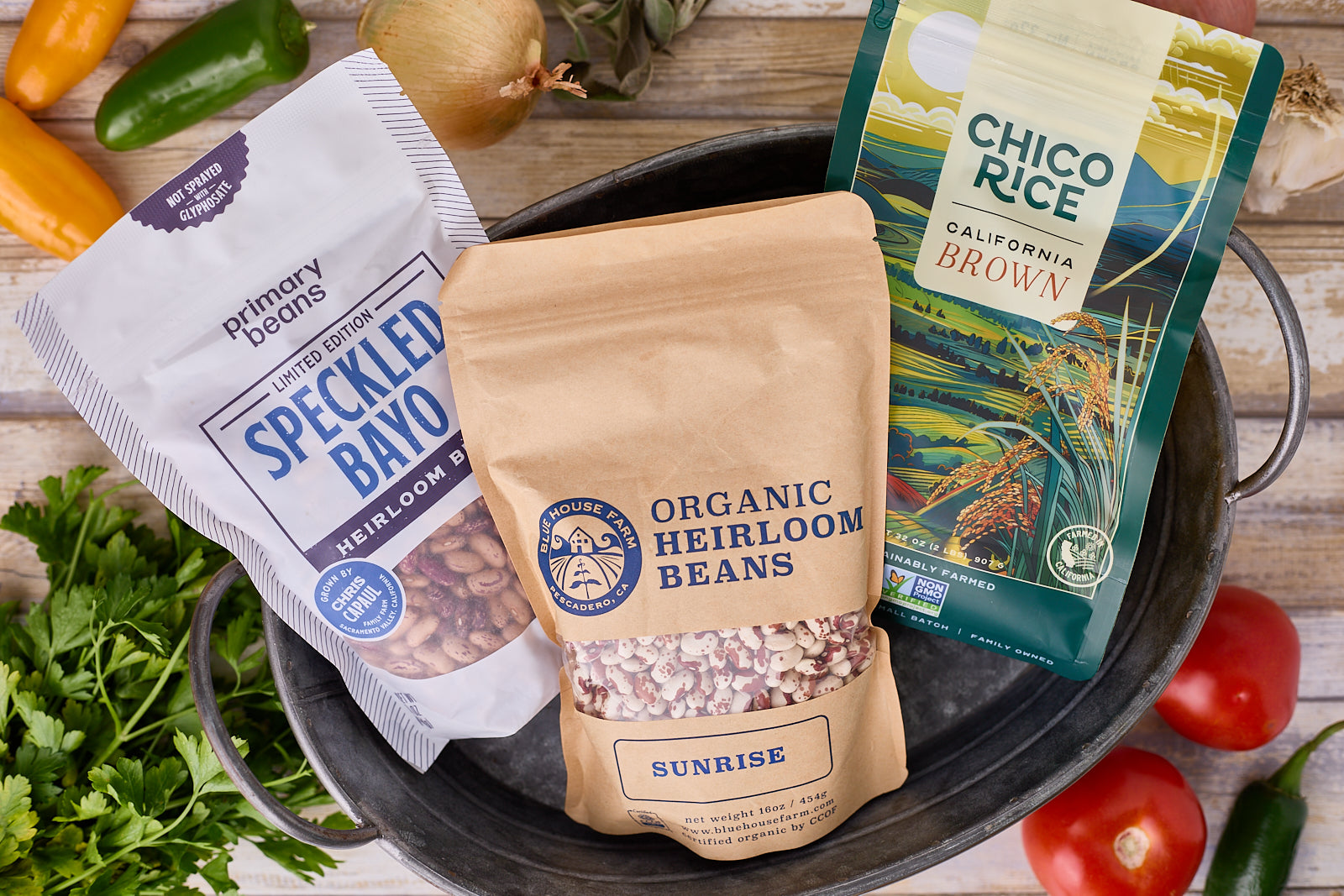
This month's Heirloom Bean and Grain Club is a love letter to California agriculture, and we couldn't be more excited about it. We're keeping it close to home with three incredible ingredients that tell the story of this state's long and rich farming history, from the fertile Sacramento Valley to the fog-kissed coast of Pescadero. First up, the limited edition Speckled Bayo bean, grown by Chris Capaul in the Sacramento Valley, once the heartbeat of heirloom bean production in the entire country thanks to our incredible climate and mineral-rich soil. From Pescadero, we're thrilled to offer a club exclusive: the Sunrise bean, an organically grown adaptation of the heirloom Zuni bean from our friends at Blue House Farm. Rounding out this month's selection is Chico Brown Rice, a fresh-milled California Japonica ancient grain grown using regenerative practices in the Sacramento Valley, a variety with deep roots here, brought by Japanese immigrants in the early 1900s who recognized that the valley's heavy clay soil was made for short grain rice. And because we believe "if it grows together, it goes together," we just had to create a Cali spin on red beans and rice using the Speckled Bayo and California Brown Rice. For those of you that get the Bean Only version, we have saved for you the very last of the Organic Mayflower Beans, a club favorite. We won't be able to get any more until 2027 at the earliest.
Speckled Bayo, Organic Sunrise Beans, Chico Japonica Brown Rice
THE BEAN ONLY CONTAINS:
Speckled Bayo, Organic Sunrise Beans, Organic Mayflower Beans

OUR CUSTOMER PORTAL
You can easily claim rewards, add to your next shipment and so much more! We made a video walking you through exactly how easy it is to add some goodies to your order and get cash back. WATCH THE VIDEO.
NEW TO THE CLUB? First of all, congratulations on scoring a spot. It's going to be harder to get in this year because of low yields from key farmers like Blue House Farms. Check out our blogposts with everything you need to know to get the most out of your membership in the heirloom bean and grain club.
How To Cook A Perfect Pot of Beans
The Definitive Guide To Cooking Beans

 SPECKLED BAYO BEANS
These are the first beans of the new harvest! We are so excited to share this rare regional gem with you, fresh from the farm. An old favorite in pockets of Coastal California and Louisiana, the Speckled Bayo has been grown by the Capaul family in Northern California since the 1800s, preserving this beloved bean for the next generation of farmers and bean lovers.
We love its naturally varying burgundy-and-cream skin tones and substantial size. It tastes similar to a kidney bean but with more of the earthiness of a pinto. Creamy yet holds its shape, with a flavor some describe as ham-like.
Once grown in family gardens and small farms across the region, the Speckled Bayo is now in danger of dying out. Customers tell us their grandparents grew it and they thought they'd never see it again. Thank you for being part of keeping this bean around for future generations!

WHAT TO DO WITH THEM
Speckled Bayo tastes like the delicious love child of a pinto and a kidney bean. It's an excellent upgrade from your typical kidney bean in chili or red beans and rice. Enjoy the farmer's family recipe for chili beans with them or our plant-based version of Red Beans and Rice which is excellent with the nutty Chico Brown Rice in your box.
COOKING TIME (from dry) Pressure Cooker 40 minutes, Stovetop 120 - 180 minutes
ABOUT THE FARMER
 Sacramento Valley has a long history of producing butter beans, which love its warmer climate compared to other California regions. Chris Capaul’s family has been growing diverse beans and vegetables since 1915 – in fact, he still has the original horse-drawn bean cutter! While bean production has declined and farms have gotten bigger through consolidation, Chris stands out as an innovator – perfecting his rotations of vine-type baby butter beans and rice, and preserving Speckled Bayo beans, a rare variety his father once grew. His careful growing methods nurture the land and produce beans far richer in flavor. Read more about Chris in a Q&A with Lesley Sykes.
ORGANIC SUNRISE BEANS
We are so lucky to have these gorgeous organic Sunrise Beans from our dear friends at Blue House Farm, and we mean lucky. Yields were heartbreakingly low this year, so this is truly a special, limited offering just for the club. If you're not familiar with the Zuni bean, also known as the Four Corners bean, it's one of the most beloved heirloom beans around with incredible flavor, silky texture, the kind of bean that makes you want to eat it straight from the pot. The problem? It's notoriously difficult to grow in our changing climate, which is why organically grown Zuni beans are nearly impossible to find. Enter the Sunrise bean. Developed in a multi-year breeding program by UC Davis, the Sunrise was bred directly from Zuni seed with one goal in mind: preserve every bit of that legendary flavor and texture while building in the climate resilience that small family farms need to thrive without relying on chemical and synthetic inputs. The result is a bean that is every bit as delicious as its ancestor and a whole lot more forgiving to grow. We think you're going to love it.
WHAT TO DO WITH THEM
These creamy beans are so flavorful that a simple pot of brothy beans is transcendent. All you need is some crusty bread to soak up that liquid golden pot liquor. Pair these beans with onion, garlic, thyme, parsley and a bit of parmesan rind along with a good glug of olive oil. They're also fantastic in grain bowls, where that rich broth becomes the base for a complete meal.
ABOUT THE FARM
Blue House Farm grows drop dead gorgeous beans from the gorgeous, fertile land in Pescadero and San Gregorio, California. Ryan Casey became interested in farming in college while taking agriculture courses. After completing an apprenticeship at the Center for Agroecology and Sustainable Food Systems and working on several farms, he decided to start an organic farm. The farm started in 2005 on 2 acres and has steadily grown to over 75 acres in production. Farming in two different microclimates allows Blue House Farm to grow over 50 types of certified organic farm products. Among the lettuce, tomatoes, herbs and peppers Blue House Farm grows excellent organic beans.
We are wishing them luck in a challenging year with less to sell, thank you for helping support small farms like Blue House Farms so that they'll be around for generations to come.
CHICO BROWN JAPONICA RICE
Seven thousand years ago in ancient China, farmers first cultivated what we now know as Japonica rice, one of the oldest domesticated crops on earth. It traveled across Asia over millennia before Japanese immigrants brought it to California's Sacramento Valley in the early 1900s, recognizing something in the heavy clay soils of Northern California that felt familiar. They were right. That land turned out to be some of the finest rice-growing country in the world, and it has been ever since.
Chico Rice has been farming that same Northern California land since 1928, and they are doing it the right way. No harmful chemicals, no shortcuts, just a deep and abiding commitment to keeping the land healthy for whoever farms it next. What ends up in your bag is something pretty special: freshly milled brown rice with the full bran layer intact, never sitting in a warehouse losing its fragrance and vitality. The aroma alone will stop you in your tracks, nutty, toasty, and deeply fragrant in a way that most brown rice simply isn't. The texture is chewy and satisfying, the flavor bold and complex.
WHAT TO DO WITH IT
This is a grain worth building a whole meal around, whether that's a grain bowl, a creamy risotto, a sizzling stir fry, or our Cali spin on red beans and rice. Ancient grain, California roots, freshly milled.
Stovetop Directions:
Rinse 1 cup of rice. In a medium saucepan, bring 2 cups of water to a gentle boil. Add the rinsed rice to the boiling water. Reduce the heat to low, cover with a tight-fitting lid. Simmer on low for 40 minutes. Remove from heat and let stand, covered, for an additional 5 minutes. Fluff the rice with a fork and serve.
RICE COOKER DIRECTIONS
Rinse 1 cup of rice and place it in the rice cooker. Add 2 cups of water and close the rice cooker. Close the rice cooker and start the cooking cycle. Once the cooking cycle is complete, let it sit for about 5 minutes with the lid closed to allow for steam absorption. Fluff the rice with a fork and serve.
INSTANT POT DIRECTIONS
For every 1 cup of rice make sure to add 1 cup of water. Rinse 1 cup of rice. Place the rinsed rice in the Instant Pot. Add 1 cup of water. Close the Instant Pot lid and set the steam valve to seal. Cook on high pressure for 22-24 minutes. Allow for a 10-minute natural release. Turn the valve to "Venting" for a quick release. Fluff the rice with a fork and serve.
ABOUT THE FARMERS
 Chico Rice is a father and son operation, four generations into farming the same Northern California land their family has tended since 1928. For years they operated as a certified organic farm, and their commitment to clean, responsible farming hasn't wavered one bit. But they made a decision that we really respect: they chose to let the organic certification go. Not because their standards slipped, but because they discovered that the approved organic practices required significantly more of California's precious water resources to produce what they felt was a lower quality rice. In a state where water is everything, that mattered to them. Rather than burning their fields after harvest, a still-common practice that fills the valley air with smoke every fall, this family blends crop residue back into the soil, building soil structure season after season and creating vital habitat for the wildlife that calls their farm home. The certification may be gone but the ethos is very much alive.

The Heirloom Bean + Grain club
Learn More
Get impossible to find beans and grains shipped direct to your doorstep each month from small family farms.

Support small family farms
Shop Now
We support small, family owned farms across the nation. Did you know that farmers only make an average of 10 cents on every dollar you spend at the supermarket? Working directly with farms and not middle men ensures that more money goes back to the people actually growning your food.