


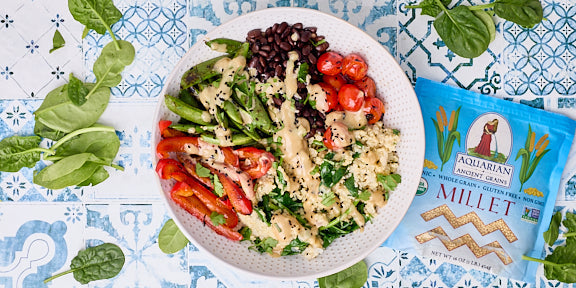

Spring Millet Black Bean Buddha Bowl with Lemon Tahini Dressing
As the weather warms up and I'm starting to get out in the garden I yearn for healthy bean and grain bowls for easy weeknight dinners. This one — blistered cherry tomatoes, charred snap peas, grilled bell pepper, fresh herbs, lemon tahini dressing — is built around two ancient ingredients that pack a serious nutritional punch: black tepary beans and millet. Both are drought tolerant in a way that isn't a marketing claim, it's just their nature. Both are genuinely nutritious rather than nutritious-adjacent. And both happen to make this bowl taste like something you'd eat every week if you kept the ingredients stocked, which you should.
Black Tepary Beans

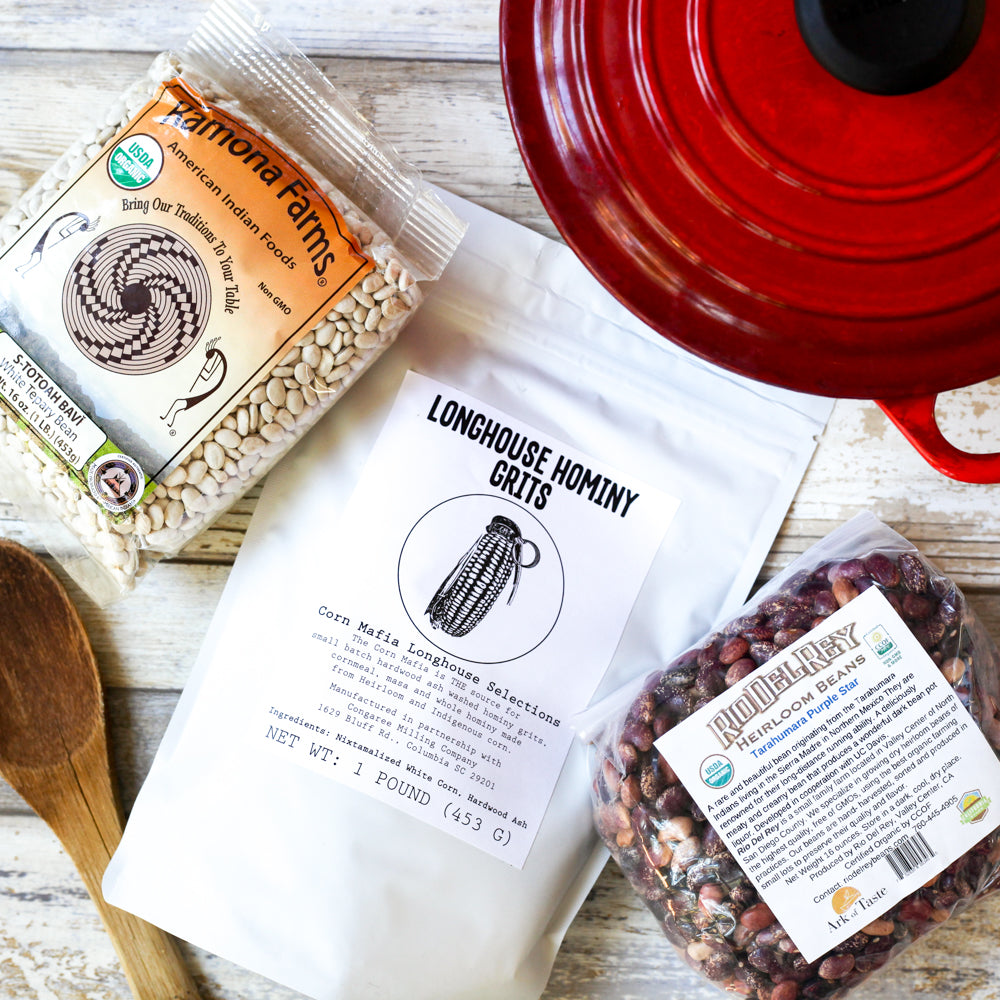
The black tepary bean has been growing in the Sonoran Desert for thousands of years, and it has sustained Native American communities through conditions that would stop most crops entirely. It is widely considered the world's most drought-tolerant bean — evolved for arid heat, minimal water, and poor soil. It's also a nutritional standout: higher in protein and fiber than most other beans, with a low glycemic index and a subtly earthy, almost nutty flavor. The tepary nearly disappeared in the 20th century when water scarcity forced many small subsistence farmers off their land. It was brought back from near-extinction by Ramona Farms, an Akimel O'odham family farm on the Gila River Indian Community in Arizona, where community elders asked the family to revive the crop in the late 1970s. They found the original seeds — saved by Ramona's father — in glass jars in an old adobe house. The beans we carry are organic, grown by Ramona Farms on that same ancestral land.
Millet

Millet has been cultivated for roughly 10,000 years across Africa and Asia, and it has spent most of that time being quietly underrated. It grows in poor, dry soil with minimal water and almost no need for pesticides — which is a shorter way of saying it has a low carbon footprint and thrives where other grains won't bother. The United Nations named 2023 the International Year of Millets specifically to draw attention to its potential role in climate-resilient food systems, so if you were waiting for institutional validation, there it is. Nutritionally, millet holds its own against wheat and rice — it's a good source of magnesium, phosphorus, and protein, it's gluten-free, and it has a low glycemic index. It also cooks up light and slightly fluffy, which makes it a better base for a bowl like this than it gets credit for. We use whole grain millet from Aquarian Farms.

Related Recipes



The Heirloom Bean + Grain club
Learn More
Get impossible to find beans and grains shipped direct to your doorstep each month from small family farms.


Support small family farms
Shop Now
We support small, family owned farms across the nation. Did you know that farmers only make an average of 10 cents on every dollar you spend at the supermarket? Working directly with farms and not middle men ensures that more money goes back to the people actually growning your food.
Millet Black Bean Buddha Bowl with Lemon Tahini Dressing
Lisa Riznikove
2 generous bowls
1566
Ancient, drought-tolerant black tepary beans and whole grain millet anchor this spring buddha bowl with charred vegetables, avocado, and lemon tahini dressing.

Ingredients
- 1 cups dry black tepary beans
- 4 inch strip of Kombu
- 1.5 cups dry whole millet
- 3 cups water or vegetable broth
- 4 cups baby spinach
- 2 cups cherry tomatoes
- 2 cups snap peas, trimmed
- 1 red bell pepper, sliced into strips
- ¼ cups fresh chives, thinly sliced
- ¼ cups fresh basil leaves
- ¼ tablespoons parsley, chopped
- 2 tablespoons olive oil
- 1 teaspoons kosher salt
For The Dressing
- ⅓ cups tahini
- 1 small garlic clove, grated or finely minced
- 3 tablespoons fresh lemon juice
- 1 tablespoons extra-virgin olive oil
- 1 tablespoons maple syrup or honey
- 1 teaspoons toasted sesame oil
- ⅓ teaspoon sea salt
- 2 tablespoons water, to thin the dressing
Topping
- 1 teaspoons nigella seeds
Directions
Cook the beans (day ahead): Rinse 1 cups black tepary beans, dried and place in a large pot. Cover with water by 2 inches and add a teaspoon of salt and 1 kombu strip. Bring to a boil then reduce to a simmer. Cook 2-3 hours until tender throughout. Cool in their liquid and refrigerate. Black tepary beans hold their shape well — don't rush them. * soaking cuts down cooking time or cook them for 40 minutes in a pressure cooker.
Make the lemon tahini dressing: Whisk together 0.3 cups tahini, 1 small garlic clove, grated or finely minced, 3 tablespoons fresh lemon juice, 1 tablespoons extra-virgin olive oil, 1 tablespoons maple syrup or honey, 1 teaspoons toasted sesame oil, and 0.3 teaspoons sea salt. Add cold water if needed to thin the dressing a little at a time until the dressing is pourable but still creamy. Taste and adjust — more lemon if it needs brightness, more tahini if it needs body. Set aside
Toast and cook the millet: Rinse 1.5 cups millet well. In a dry saucepan over medium heat, toast the millet, stirring frequently, until it smells nutty and a few grains begin to pop. Add 3 cups water or vegetable broth and 1 teaspoons kosher salt, bring to a boil, then reduce to a low simmer. Cover and cook until the liquid is absorbed, about 15-18 minutes. Remove from heat.
Wilt the spinach into the millet: While the millet is still hot, fold in 4 cups baby spinach and half of the herbs in two or three additions, stirring gently between each. The residual heat will wilt the spinach just enough — you want it softened but still bright green. Cover and let rest 5 minutes.
Char the tomatoes, peppers and snap peas: Toss olive oil and a pinch of salt. Place in a grill basket over high heat (or under the broiler on a sheet pan). grill for a few minutes on each side, until the tomatoes are blistered and beginning to burst and the snap peas and red peppers have some charred edges.
Assemble: Divide the warm millet-spinach base between bowls. Arrange the drained black tepary beans, blistered tomatoes, charred snap peas, grilled bell pepper strips on top. Drizzle generously with the lemon tahini dressing. Scatter the remaining herbs, and the nigella seeds over each bowl and serve immediately.