



Dense Chickpea Salad
If you've spent any time on social media in the past two years, you've encountered the dense bean salad. Creator Violet Witchel, known as Dense Bean Salad Girl, has 2.8 million followers and a video with over 13 million views built around a simple idea: a lot of beans, some vegetables, a good dressing. She now has a substack that you should definitely signup for and she's doing pop-ups which you should absolutely attend if you can (she announces them on social media). She sold out 200 presales in Philadelphia in under half an hour. I have serious FOMO about her popups!
The concept isn't new. Marinated bean salads have been around forever. What's new is that everyone suddenly remembers they're great.
Here's the version we make.
What Makes a Dense Bean Salad Different
It's not a green salad with beans on top. The beans are the point. They're dense, satisfying in the way that a bowl of pasta is satisfying, and because they absorb the dressing as they sit, they get better over time instead of worse. Make it Sunday, eat it all week. The vegetables stay crisp. The flavors deepen. It's one of the better meal-prep situations in existence.
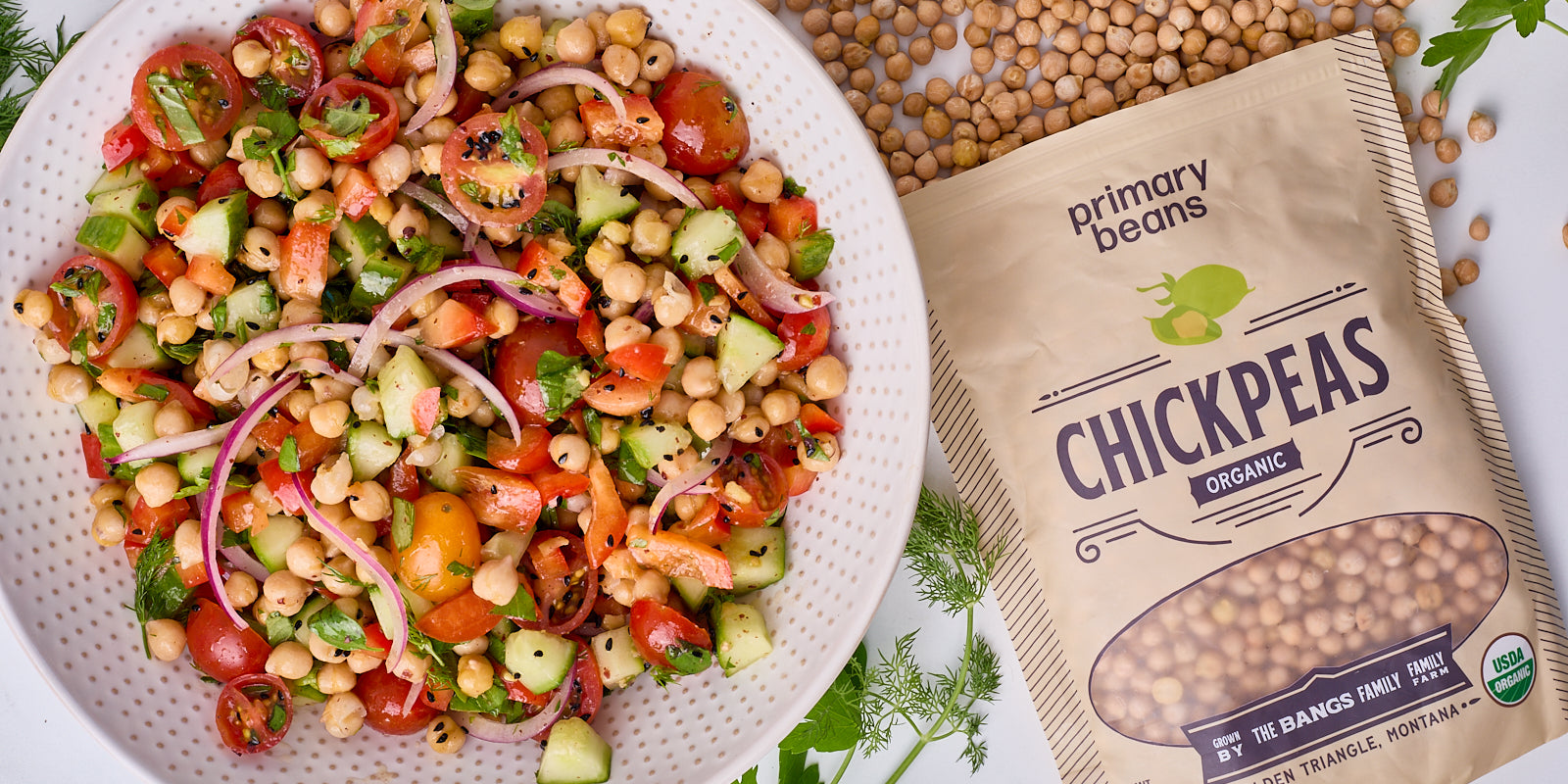
The version everyone makes uses canned chickpeas. Nothing wrong with that. But our organic chickpeas cooked from dried are a different experience, nuttier, firmer, with a creaminess at the center that a canned bean doesn't have. The dressing has four ingredients. The beans have to do the flavor work, and ours can.
Why Sumac and Nigella Seeds
Most dense bean salad recipes use red wine vinegar or lemon as the acid. This one also uses sumac, a ground berry that has been used as a souring agent across the Middle East for thousands of years, long before lemons arrived in the region. If you've eaten fattoush, you've tasted what sumac does: it's responsible for both the signature tang and the deep brick-red color of the dressing. Same principle here. It's tarter and more complex than lemon, with a slightly fruity edge that lemon doesn't have.
Nigella seeds go on at the end. They're rich in antioxidants, essential fatty acids, and a bioactive compound called thymoquinone, which has been studied for its anti-inflammatory and immune-supporting properties. They've been used medicinally across Middle Eastern, Indian, and North African cultures for centuries. As a finishing seed on a salad, they look like black sesame but taste completely different, mild, faintly oniony, with a slight bitterness that keeps the whole bowl from being one-note. They're one of our favorite ways to add both nutrition and texture without doing much work.
The Beans Matter More Than Anything
The standard dense bean salad advice is to drain, rinse, and dry your canned beans before adding them to the dressing so they absorb it properly. That's true. If you're cooking from dried, which we'd encourage, the same principle applies: cook your chickpeas, let them cool, and add them to the dressing while they're still slightly warm if you can. They'll drink it in.
How to Serve It
On its own for lunch, it's filling enough. As a side at a cookout alongside grilled meat or fish. Spooned into pita with a smear of yogurt. Over a handful of arugula if you want to stretch it.
It also works as a starting point. Add a second bean, our Black Garbanzo beans are striking against the regular chickpeas, black and tan in the same bowl, or throw in some crumbled feta if you want something richer.
The one thing that doesn't improve it: making it at the last minute. Give it at least ten minutes to rest. An hour is better. The beans are the whole point, and they need a little time to actually absorb what you've put on them.
A Note on the Herbs
Dill and basil together sounds like an unlikely combination. It works. The dill brings a brightness that cuts through the richness of the olive oil; the basil adds a sweetness that rounds it out. Both go in at the end, after the salad has had time to rest, so they stay fresh rather than wilting into the dressing.
If you only have one or the other, use what you have. If you have cilantro and prefer it, use that instead, it's also excellent here.



The Heirloom Bean + Grain club
Learn More
Get impossible to find beans and grains shipped direct to your doorstep each month from small family farms.

Support small family farms
Shop Now
We support small, family owned farms across the nation. Did you know that farmers only make an average of 10 cents on every dollar you spend at the supermarket? Working directly with farms and not middle men ensures that more money goes back to the people actually growning your food.
Dense Chickpea Salad
Lisa Riznikove
4-6
15 minutes
35 minutes
330
Middle Eastern-Inspired
Salad
The viral dense bean salad, made with heirloom chickpeas that actually taste like something. Sumac, nigella seeds, fresh herbs. Ready in 10 minutes.

Ingredients
- 3 cups cooked organic chickpeas
- 1 English cucumber, diced small
- 1 cups cherry tomatoes, halved
- 1 red bell pepper, diced small
- 0.3 cups fresh dill, roughly chopped
- 0.3 cups fresh basil, torn
- 3 tablespoons extra virgin olive oil
- 3 tablespoons fresh lemon juice (about 1 large lemon)
- 1 garlic clove, minced or grated
- 1.5 teaspoons sumac
- ½ teaspoons kosher salt
- 1 teaspoons nigella seeds, for finishing
Directions
Cook the chickpeas: Rinse and put cover with 2-3 inches of water in a pressure cooker or heavy cooking pot, add one teaspoon of salt and a drizzle of olive oil and cook until creamy. 35 minutes in the pressure cooker or approximately 90 minutes on the stovetop.
Make the dressing: In a large bowl, whisk together 3 tablespoons extra virgin olive oil, 3 tablespoons fresh lemon juice (about 1 large lemon), 1 garlic clove, minced or grated, 1.5 teaspoons sumac, and ½ teaspoons kosher salt. Let it sit for a minute — the sumac will bloom in the acid and deepen in color.
Add the vegetables: Add the 3 cups cooked heirloom chickpeas (or 2 cans, drained and rinsed), 1 English cucumber, diced small, 1 cups cherry tomatoes, halved, and 1 red bell pepper, diced small to the bowl. Toss well to coat everything in the dressing.
Rest: Let the salad sit for at least 10 minutes before serving. The chickpeas will absorb the dressing and everything gets better. An hour in the fridge is even better.
Finish and serve: Fold in the ⅓ cups fresh dill, roughly chopped and ⅓ cups fresh basil, torn just before serving. Scatter 1 teaspoons nigella seeds, for finishing over the top. Taste for salt and lemon — adjust as needed.